Skip to content
Rackzar

Rackzar Network Overview

South Africa's premier carrier-neutral network with triple-redundant IP transit and extensive peering across major internet exchanges

Autonomous System
AS329206
IP Transit
3 Upstreams
Peering Policy
Open
IPv6 Support
Native

About Our Network

Rackzar operates AS329206, providing robust, redundant connectivity across South Africa's premier data centres

Network Overview

Rackzar's autonomous system (AS329206) is a Network Service Provider operating across South Africa with an open peering policy. Our network is designed for reliability, performance, and scalability.

  • Carrier-neutral infrastructure
  • Three independent upstream carriers
  • Native IPv4 and IPv6 support
  • 24/7 NOC monitoring

Open Peering

We maintain an open peering policy to ensure optimal routing and performance for our customers. Our presence at major South African internet exchanges enables direct, low-latency connections.

  • Open peering at IXPs
  • Private peering available
  • BGP best practices
  • Route optimisation

Network Security

Engineered for uptime: layered network security, RPKI-validated routing, strict prefix filters and diverse upstreams. Private VLAN isolation and a dedicated management plane with role-based access.

  • DDoS mitigation
  • RPKI validation
  • BGP security filtering
  • 24/7 security monitoring

Three upstream carriers, one resilient network

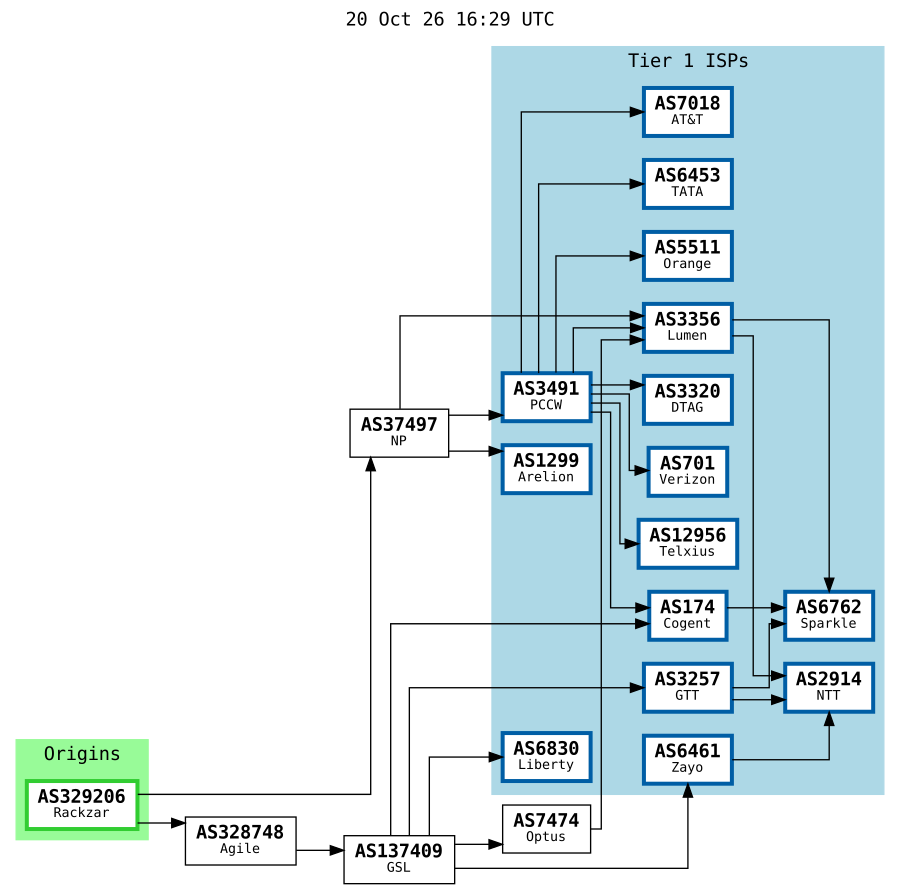
Rackzar takes IP transit from three independent upstream providers: Workonline, Agile and Network Platforms. Each carrier reaches us over separate physical paths and separate BGP sessions, so a fibre cut, a maintenance window or an upstream incident on any one of them does not interrupt your traffic.

Most South African hosts run one or two upstreams. Running three means we can lose a carrier entirely and still hold full redundancy on the remaining two, rather than dropping to a single point of failure while the fault is repaired. Multi-homed BGP lets us shift traffic between carriers in seconds and select the shortest path to each destination network rather than accepting whatever one provider advertises.

3 Upstream carriers
4 Internet exchanges
N+2 Transit redundancy

Our upstream networks, and their public PeeringDB records:

AS37271
AS328748
AS37497
BGP path diagram showing AS329206 upstream connectivity via Workonline AS37271, Agile AS328748 and Network Platforms AS37497
Observed routing paths for Rackzar AS329206, based on data from bgp.tools.

Network Infrastructure Map

Interactive visualisation of our data centre locations, national long distance paths, and submarine cable connectivity across South Africa

Private Network Interconnects - (PNI's)

Direct private peering with major cloud and content providers for optimal performance and reduced latency

Google

Direct interconnect to Google Cloud Platform and Google services

Microsoft

Private peering with Azure and Microsoft 365 services

Amazon

Direct Connect to AWS infrastructure and services

Cloudflare

Private Network Interconnect with Cloudflare's global network

Oracle

Direct interconnect to Oracle Cloud Infrastructure (OCI) and Oracle services

Connect Rackzar and hyperscaler workloads directly

Our private interconnects give your servers high-speed, direct links to Google Cloud, Microsoft Azure, AWS, Cloudflare and Oracle Cloud. Traffic between your Rackzar infrastructure and your cloud workloads takes the shortest path, rather than crossing third-party transit networks.

Distributed hosting designs

Run databases and core systems on dedicated Rackzar hardware while front ends, storage or managed services live in the cloud, with fast links between them.

Multi-cloud deployments

Combine Rackzar with one or more hyperscalers to avoid lock-in to a single provider and place each workload where it runs best.

Low, consistent latency

Direct interconnects reduce hops between your environments, keeping API calls, replication and data transfers fast and predictable.

Backup and disaster recovery

Replicate between Rackzar and the cloud over high-capacity links, so a secondary site is always close to your primary data.

Use your own ASN and IP space on our hardware

If your organisation holds its own Autonomous System Number and IPv4 or IPv6 address space, you do not need to renumber when you move to Rackzar. We set up a BGP session with your ASN and route your prefixes across AS329206, so your own addresses work on our dedicated servers, colocation and private cloud.

Your prefixes are carried by our three upstream carriers and announced at the internet exchanges we peer at, giving your address space the same multi-homed resilience as our own network.

  • No renumberingKeep IP addresses already in DNS records, firewall rules and client allow lists.
  • Your network identityTraffic is routed from your own ASN, keeping your IP reputation and routing policy under your control.
  • Multi-homed by defaultYour prefixes benefit from three upstream carriers and direct IX peering.
Talk to Our Network Team

What you will need

  • Your own ASNRegistered with AFRINIC or another regional internet registry
  • Your own IP spaceIPv4 /24 or larger, IPv6 /48 or larger
  • Letter of AuthorityConfirming you are authorised to route the prefixes
  • RPKI ROAsValid ROAs covering each prefix and its origin ASN
  • IRR route objectsMatching route objects so our filters accept your announcements

How it works

  1. Share your detailsSend us your ASN, prefixes and Letter of Authority.
  2. We verifyWe check registry, RPKI and IRR records for each prefix.
  3. BGP session goes liveWe bring up a session with your ASN and accept your prefixes.
  4. Route to your hardwareYour addresses are assigned to your Rackzar services.

Carrier Grade Networking Hardware

Our routing and switching runs on Juniper and Arista, platforms built for carrier networks rather than general-purpose x86 servers. It costs more to build this way, and it is why latency stays consistent when traffic peaks.

  1. 01 Transit & IX 3 upstream carriers and 4 exchanges at up to 100G
  2. 02 Juniper core & edge Full BGP tables, RPKI validation and MPLS
  3. 03 Arista switching Fully redundant access layer, sub-microsecond latency
  4. 04 Your server VPS, dedicated and cloud services
How your traffic moves through AS329206
Juniper Networks Routing

Core & edge routing

Juniper routers run the AS329206 backbone, carrying full BGP tables from all three upstreams and four exchanges with advanced traffic engineering.

  • BGP & RPKI
  • MPLS
  • Traffic engineering
  • Native IPv4 / IPv6
  • Carrier-grade reliability
Arista Networks Switching

Access layer & switching

A fully redundant Arista switching fabric connects every server, built for latency-sensitive applications and high-throughput workloads.

  • 100% redundant
  • Sub-microsecond latency
  • Zero packet loss design
  • CloudVision
  • SDN ready

Consistent latency

Forwarding happens in dedicated silicon, so latency does not drift with CPU load or traffic spikes.

Steady at peak demand

Line-rate ports and redundant uplinks keep throughput level during busy periods instead of queuing and dropping packets.

Full feature parity

MPLS, BFD, RPKI validation and full BGP tables run natively, with no software workarounds.

ZA Points of Presence

Strategic locations across South Africa's leading carrier-neutral data centres, including Uptime Institute Tier IV certified Africa Data Centres JHB2

Johannesburg

3 POPs
  • JHB1 Xneelo Midrand ISO 27001 & PCI DSS
  • JHB2 Africa Data Centres Samrand Uptime Tier IV certified
  • JHB3 Teraco Isando ISO 27001 & PCI DSS

Cape Town

3 POPs
  • CT1 Africa Data Centres Diep River ISO 27001 & PCI DSS
  • CT2 NTT Bellville ISO 27001 & PCI DSS
  • CT3 Teraco Rondebosch ISO 27001 & PCI DSS

Network Questions

Common questions about capacity, peering, redundancy and connectivity on AS329206

What is the capacity of your network?

Our network peers at 100Gbit across major South African internet exchanges, providing extremely low latency and high throughput for all hosting services.

Which internet exchanges do you peer with?

We peer directly at JINX, NAPAfrica, CINX and INX-ZA, ensuring optimal routing to ISPs, CDNs and cloud services across South Africa.

How many upstream providers do you use?

Three. We take IP transit from Workonline (AS37271), Agile (AS328748) and Network Platforms (AS37497), each over separate physical paths and separate BGP sessions. Losing any one carrier still leaves two fully redundant upstreams rather than a single point of failure.

Do you use redundant network paths?

Yes. We operate fully redundant fibre paths between facilities with automatic failover to ensure service continuity even during fibre cuts.

Can I bring my own IPs (BGP)?

Yes. If you have your own ASN and IPv4 or IPv6 space, we can set up a BGP session with your ASN and route your prefixes across AS329206, so you can use your own addresses on our dedicated servers, colocation and private cloud. We need a Letter of Authority, valid RPKI ROAs and matching IRR route objects before we accept your announcements. See Bring your own IP space for details.

Is the network optimised for local South African traffic?

Yes. We maintain direct peering with major ISPs and local carriers for the lowest possible latency within South Africa.

Do you support private interconnects?

Yes, private VLANs and cross-connects are available for enterprise clients needing direct connections between racks or facilities.

Do you have IPv6 support?

Our network is fully dual-stack with native IPv6 support across all platform layers including VPS, dedicated servers and cloud products.

Where are your network POPs located?

We maintain POPs in Johannesburg and Cape Town through major carrier-neutral data centres to ensure low latency nationwide.

Ready to Connect with Rackzar?

Whether you're interested in peering, colocation, or our cloud services, our team is ready to help you leverage our network infrastructure